

Dear Jeanie,
I know this letter might generate some controversy, and I want you to know I am writing it with complete love and zero judgment. But I would not be doing my job as your dad if I did not share my honest and practical thinking about one of the most significant financial decisions you will ever make that almost nobody talks about rationally before it is too late.
Let us talk about weddings.
Is spending $30,000, $50,000, $75,000, or $100,000 or more the best financial decision for two people who are just beginning their lives together? In my honest and practical opinion, that money could be working much harder for you in ways that last significantly longer than a six hour party. And I want to walk you through exactly why I feel that way.
First let me say this clearly. If you and your future husband are financially secure, if both sets of parents can genuinely and comfortably contribute without straining their own financial situations, and if a large, elaborate wedding is something that brings you both real and lasting joy, then by all means, do it. I am not here to tell you what your wedding should look like. I am here to make sure you go into that decision with your eyes wide open about what it actually costs and what else that money could do for your life.
Because the honest truth is that right now, neither of us is in that position. And the numbers deserve to be seen clearly.
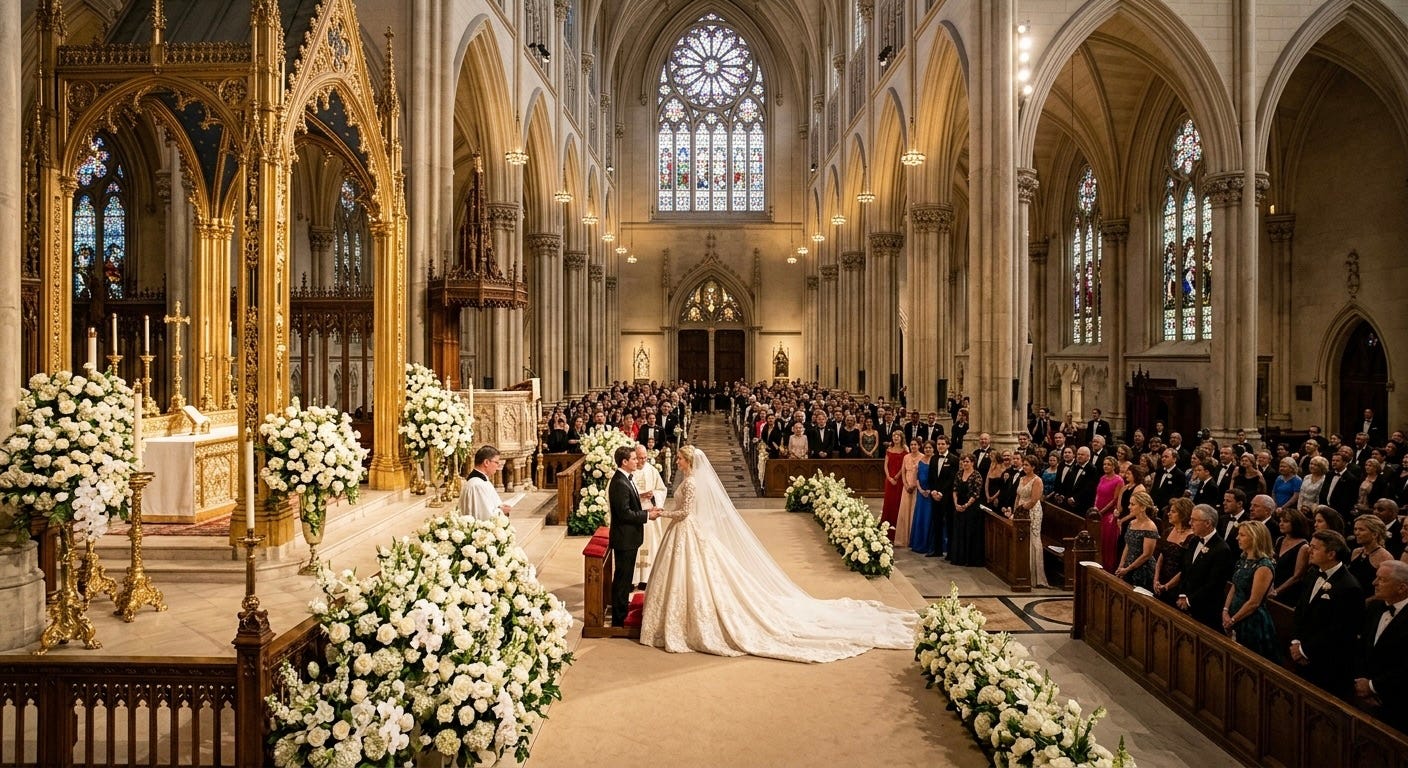
A wedding in a major city like New York with 150 or more guests runs somewhere in the range of $100,000 when you add everything up honestly. And when I say everything, I mean everything. The venue alone runs around $20,000. Catering comes in at roughly $18,000. Bar service adds another $14,000. Florals cost around $11,000. A wedding planner is approximately $8,000. Photography is $7,000. Videography is $6,000. Entertainment is $3,000. The cake and desserts are $1,500. Hair and makeup for the bride is around $1,000. And then there are all the other expenses, the tips, the incidentals, the things nobody budgets for that always appear, which add another $10,000 on top of everything else.
That is roughly $660 per guest. For a six hour event. One hour for the ceremony. One hour for the cocktail reception. One hour for dinner. And three hours of dancing and celebration. And that number does not even include the rehearsal dinner or the honeymoon.
Now I understand that New York City is an extreme example. And here is something worth knowing before you even start looking at venues and vendors. The timing of your wedding alone can save you a significant amount of money without changing a single thing about the celebration itself. Getting married during the off-peak season, meaning the winter months of January, February, and early March, or choosing a weekday rather than a Saturday, can reduce your total wedding costs by roughly 25% across almost every vendor category. Venues drop their rates dramatically. Caterers are more flexible. Photographers and videographers who are booked solid every Saturday from May through October suddenly have availability and often negotiate their pricing. That 25% savings on a $100,000 New York City wedding is $25,000 back in your pocket for doing nothing more than choosing a different date. On a $50,000 wedding that is $12,500 saved. For a Friday in February versus a Saturday in June, that is a genuinely remarkable return on a single scheduling decision. The guests who truly love you will show up on a Friday evening in January without a second thought.
You can save even further by holding the wedding outside of New York City entirely. Even in a major Texas city a comparable wedding with the same number of guests can still run anywhere from $35,000 to $75,000 or more. The numbers are different but the fundamental question remains the same.
Is this the best use of that money at this stage of your life?
Let me tell you two stories, because I think they say everything.
Your uncle had a big, beautiful, elaborate wedding. It was wonderful. The venue was stunning, the food was excellent, the party went late into the night, and everyone had a genuinely great time. It cost a significant amount of money and they were happy to spend it.
Your aunt took a completely different approach. And honestly, so did your mom and I. We both chose intimate, carefully curated celebrations with the people who mattered most. We both spent a fraction of what your uncle spent. And in both cases, we had a wonderful time. The memories from those days are just as warm, just as vivid, and just as cherished as any big elaborate wedding I have ever attended. Possibly more so, because the people in the room were exactly the people who were supposed to be there, and nothing felt forced, excessive, or performative. It felt real. And real is what you remember.
I recommend that same approach, and here is my honest reasoning for why.
Think about what that money could do for you instead. Imagine putting the difference toward a honeymoon that actually gives you five to seven nights of real travel and real experiences in a place you have always dreamed of visiting rather than a quick trip squeezed between wedding expenses. Imagine putting it toward your $100,000 emergency fund, the safety net we have talked so much about. Imagine it becoming the beginning of the down payment on your first home. Now imagine coming home from your honeymoon, with all the guests back in their cities and the last vendor invoice finally paid, and looking at your bank account. Would you rather see a number that makes you anxious or a number that gives you genuine peace of mind?
I think you already know the answer.
So here is what I actually recommend, and I want to be specific because I think the details matter.
Keep the guest list small and meaningful. Invite your closest family and your very best friends. That is it. I still remember our own wedding and how many people were in that room that I had not spoken to in years, distant relatives I barely recognized, acquaintances who filled seats but not moments. The people who matter most to you on that day are a much shorter list than the traditional invitation feels like it demands. Forget about distant family members you have not seen or spoken to in years. They will understand.
Find a venue that does the heavy lifting for you. Your aunt found a private restaurant with a garden chapel and it was genuinely beautiful, intimate, and far less expensive than a traditional wedding venue. Those places exist in almost every city. They just require a little more searching and a little more creativity than the first venue a wedding planner suggests.
For your wedding dress, I want to say something that might surprise you. Consider buying a beautiful, elegant dress rather than a traditional wedding gown. The honest reality is that a wedding dress gets worn once and then lives in a garment bag in the back of a closet for the rest of its existence. A stunning dress that you could also wear to a future gala, a formal dinner, or a special occasion gives you something that lives beyond one day. The same principle applies to your husband’s attire. Invest in a well-made tuxedo he can wear again rather than renting something that disappears the next morning.
For food and the cake, keep it simple. Nothing elaborate with multiple courses and architectural dessert displays. Good food shared with the people you love does not require a prix fixe menu or a five tier cake. Simple, delicious, and generous is exactly right.
Now here is where I do want you to spend well, because some things genuinely deserve the investment. The photographer and the videographer are the two vendors where I would not cut corners. Those photographs and that video are the only things from your wedding day that will last forever. You will share them with your children someday. You will look at them on anniversaries decades from now. You will send them to family members who could not be there. Hire talented people for this and do not let the budget squeeze this line item.
Hair and makeup for the bride is also worth doing properly. You deserve to feel extraordinary that day and that investment shows in every photograph taken from that morning onward.
And here is a structure I love for making the celebration feel complete without the enormous price tag.
Have the rehearsal dinner as a private, intimate dinner with both sets of parents, siblings, and your closest people. That dinner, more than almost any other moment of the entire wedding weekend, is where the real conversations happen, where the families genuinely connect, and where the most meaningful memories are actually made. Do it well and do it intentionally.
Then separately, plan a wedding night celebration at a great venue with your closest friends, your bridesmaids and groomsmen, your best man and maid of honor. A dinner or a night out that is entirely yours, without the formality and the structure of the reception, where you can actually be present and enjoy the people around you rather than moving from table to table for four hours making sure every guest feels acknowledged.
That combination, an intimate ceremony and dinner with family, a separate celebration with your closest friends, a genuinely wonderful honeymoon, and real savings still in your account when it is all over, is the best possible version of this milestone in my honest opinion. It gives you the meaningful moments without the financial hangover. It honors the importance of the day without starting your marriage with a bill that takes years to fully recover from.
A wedding is a day. A marriage is a life. Invest accordingly.
Love, Dad.